
Last updated October 15, 2026
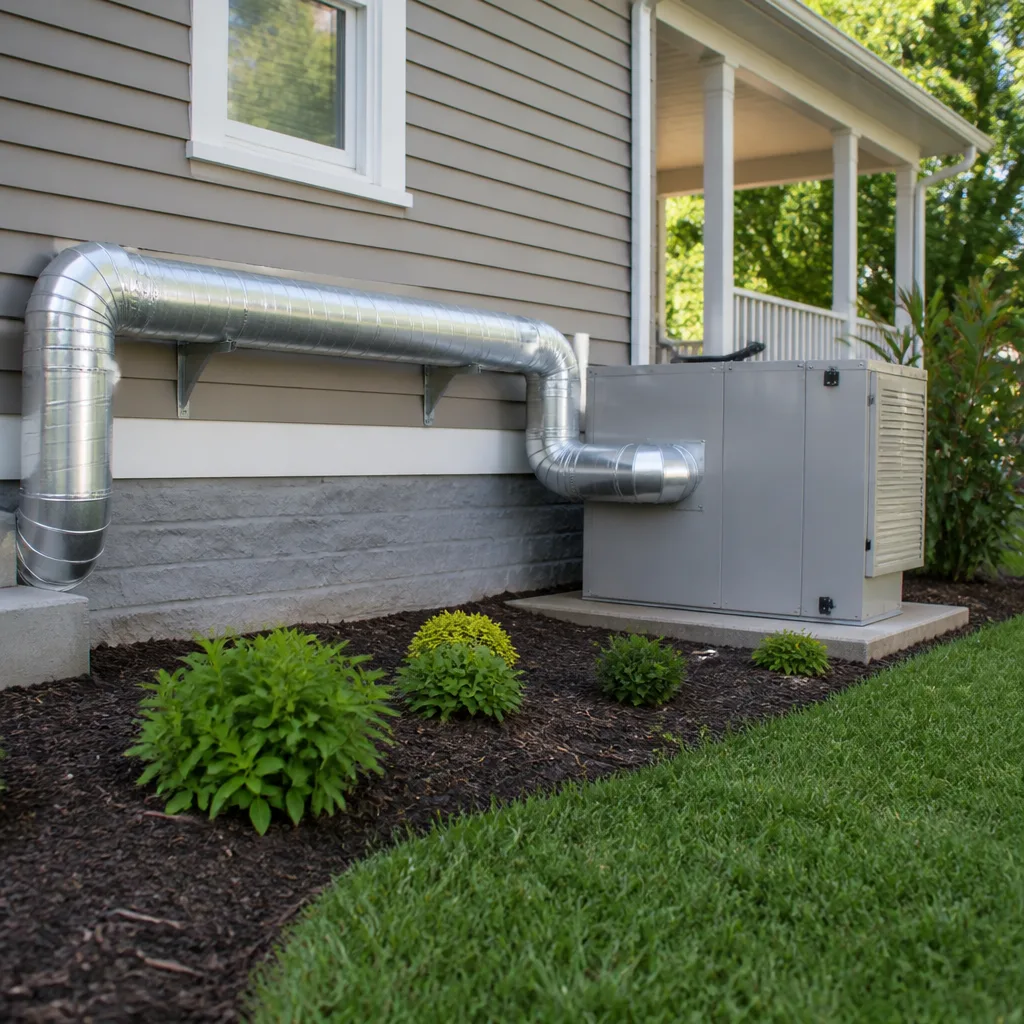 Whole-home duct cleaning
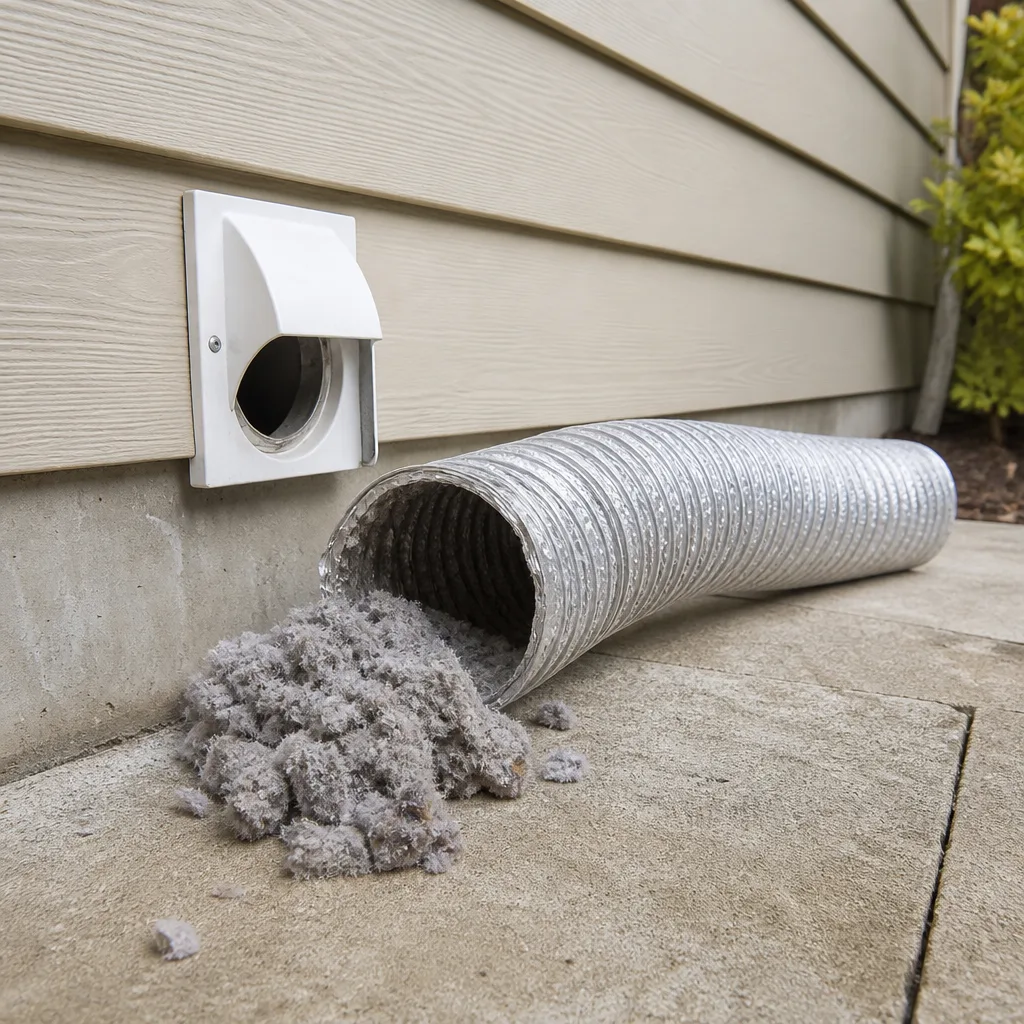 Dryer vent cleaning
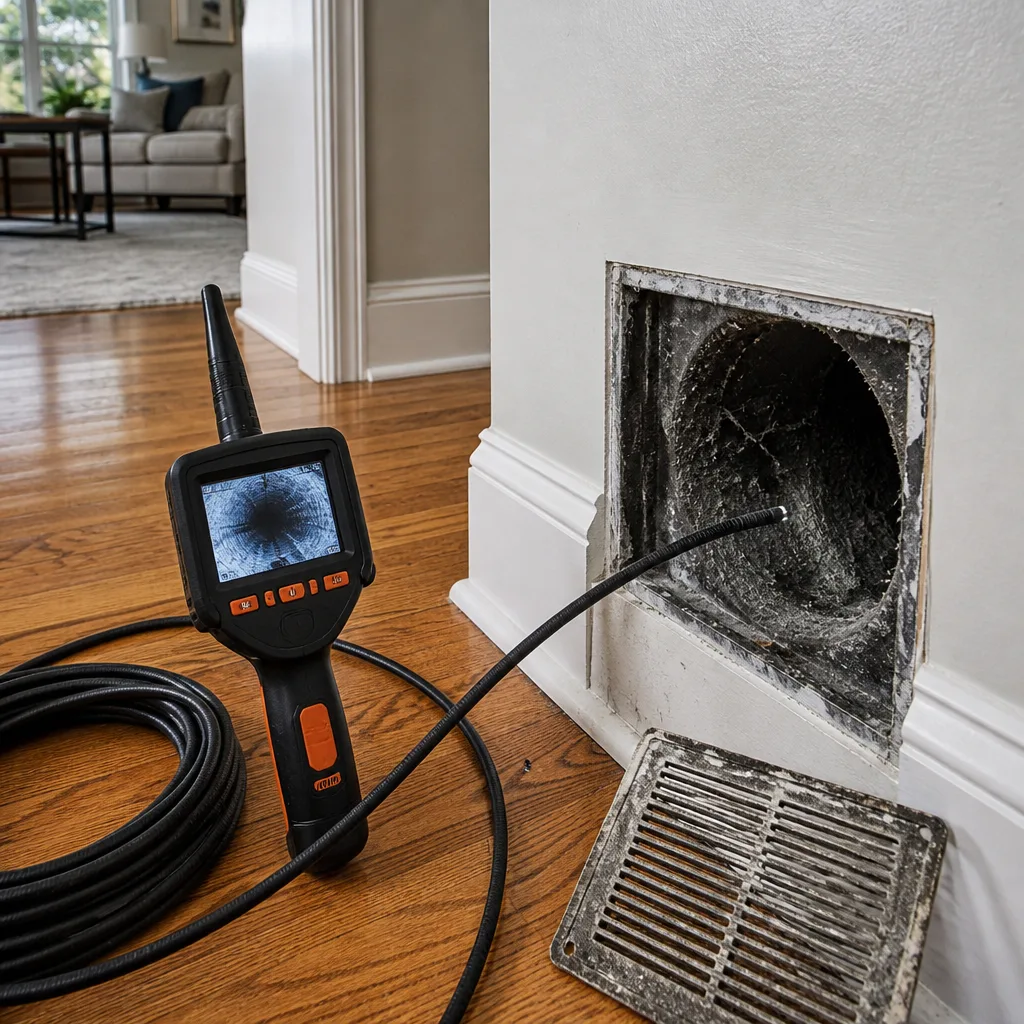 Camera inspection
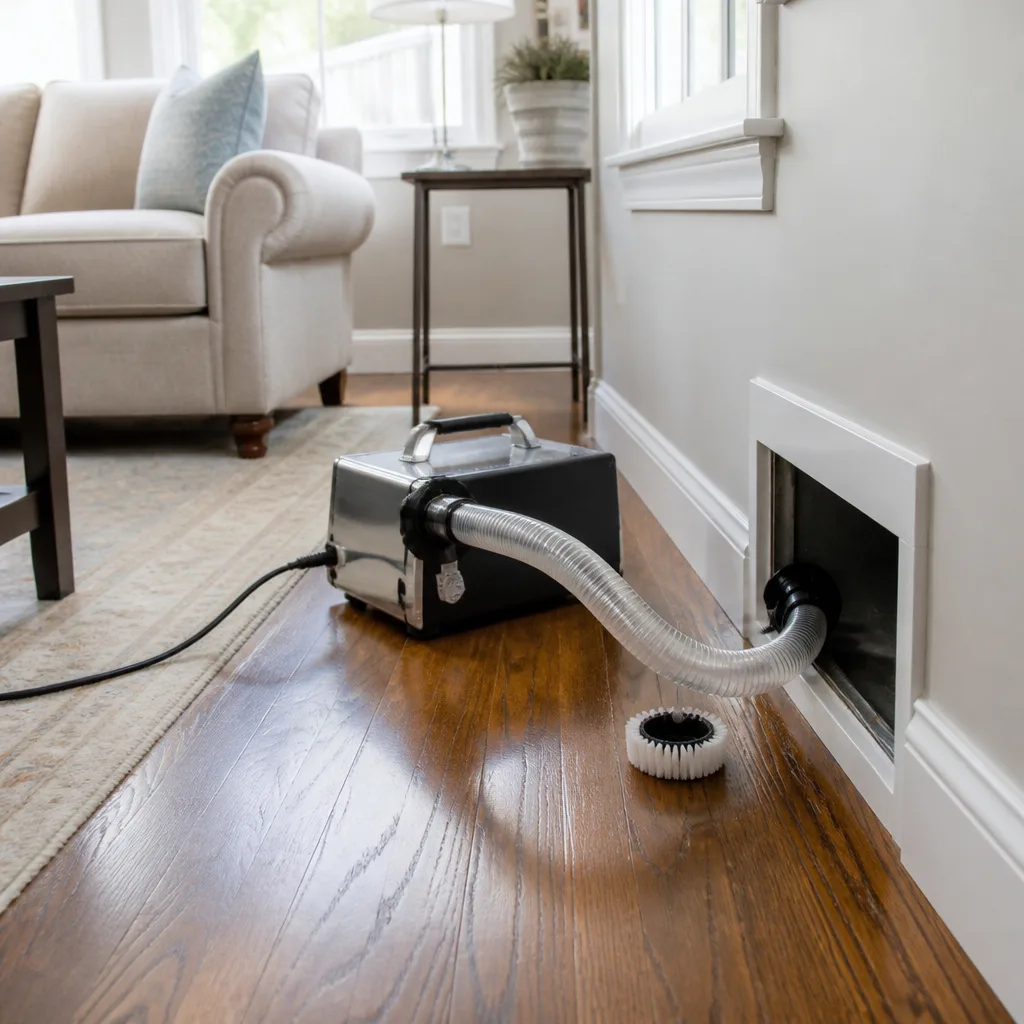 Sanitizing & deodorizing
Whole-system duct and dryer vent check with before-and-after photos - you see exactly what came out of your vents
That "$99 whole-house special" is a bait ad - the real number appears once they are in your hallway, or the "clean" is a shop-vac at the register. We photograph the inside of your ducts before and after instead.
DIY vs Professional Air Duct Cleaning: The Marietta Homeowner’s Decision Guide
Every DIY duct cleaning tutorial on YouTube shows the same scene: a homeowner unscrewing a register, jamming a shop vac hose into the opening, and declaring the job done. What those videos never show is what NADCA’s own technical standards make clear: this method cannot remove contamination past the first 12 inches of duct, and the first 12 inches is where the least accumulation actually sits. This guide is written from Marietta, Georgia, where our humidity, pollen cycles, and crawlspace construction create duct conditions that a YouTube tutorial cannot prepare you for. For a deeper look at professional solutions, see our Air Duct Cleaning services. By the time you finish reading, you’ll know exactly which tasks you can handle yourself, which ones require professional equipment, and how to tell the difference before you spend a dollar or waste a Saturday.
Quick Answer
DIY duct cleaning in Marietta is useful for exactly three things: cleaning register covers, replacing air filters, and inspecting what you can see. Everything beyond those tasks, meaning the actual removal of built-up debris from the duct trunk and branches, requires negative-pressure source removal equipment that a shop vac cannot replicate. For most Marietta homes, a professional cleaning costs between $350 and $650 for a full system, while a DIY attempt costs you a weekend and typically leaves the ducts dirtier than when you started.
Styles & brands we work with
Table of Contents
- What DIY Duct Cleaning Can and Cannot Do
- The Physics Problem: Why Your Shop Vac Fails
- What Marietta’s Climate Does to Your Ducts
- Three Legitimate DIY Tasks for Marietta Homeowners
- When DIY First Makes a Professional’s Job Harder
- What Professional Equipment Actually Does
- What a Professional Should Show You After the Job
- Cost Comparison: DIY vs Professional in Marietta
What DIY Duct Cleaning Can and Cannot Do
The honest answer from someone who has cleaned ducts in Marietta since 2004 is this: DIY has a ceiling, and that ceiling is very low. You can clean what you can touch. You cannot clean what you cannot reach, which in a typical Cobb County home is roughly 90 percent of the duct system.
Let us be specific about what that means. When you remove a register cover and look into the opening, you are seeing the final few inches of a branch duct that connects back to a main trunk line. That trunk line often runs through a crawlspace, an attic, or a finished ceiling cavity. The debris that matters, meaning the dust, pollen, pet dander, and construction material that recirculates through your home, accumulates along the entire length of that trunk and its branches, not just at the visible endpoints.
A shop vac, even a powerful one, pulls air from one point. The duct system is not a single pipe; it is a branching network that can total 40 to 80 linear feet in an average Marietta home. Suction at one register does not create meaningful airflow at the far end of the trunk. The result is that you clean the first foot or two and leave everything beyond it untouched.
What DIY realistically accomplishes:
- Register cover cleaning: Removing and washing return and supply grilles, which are often coated in a visible film of dust and cooking grease. This is genuinely worth doing and takes an hour.
- Filter replacement: Swapping a dirty filter changes air quality more than any register vacuuming ever will. A clogged filter forces your blower to work harder and lets bypass air carry unfiltered dust into the coils and ducts.
- Visible debris removal right at the opening: If you can see a clump of pet hair or construction dust sitting within arm’s reach, removing it by hand is reasonable. Just know that this is cosmetic, not systemic.
What DIY does not accomplish:
- Removing dust buildup beyond the first few feet of any branch duct
- Dislodging debris caked onto duct walls by years of humidity cycles
- Cleaning the return side of the system, which is often the dirtiest because it runs pre-filter
- Removing biological growth from condensation that forms inside ducts during Marietta summers
- Providing any verification that the ducts are actually clean
The Physics Problem: Why Your Shop Vac Fails
Here is the counterintuitive part that most DIY tutorials get wrong: using a shop vac at a register can actually make your indoor air quality worse, not better. This is not a scare tactic. It is how airflow works.
When you apply suction at one register opening, you create negative pressure at that point. But your duct system is connected to your living space through every other register in the house. The vacuum is pulling air from wherever it can get it, which means it is pulling from the path of least resistance. Often that path is not the deep trunk line; it is the short run back to the next register opening in the same room or the adjacent hallway.
What happens next is the problem. The suction disturbs loose debris sitting on the duct floor. Some of that debris moves toward the vacuum and gets captured. But a meaningful portion gets stirred up and pushed further down the duct, away from the suction point, toward areas of lower pressure. When the vacuum turns off, that now-airborne dust settles deeper in the system than where it started. You have effectively relocated the problem to a less accessible location.
We have seen this in Marietta homes more times than we can count: a homeowner spends a Saturday with a shop vac, then calls us months later because the returns are blowing visible dust. What they have done is pushed a decade of accumulated dust from the accessible branch ends into the trunk line, where it now circulates through the whole house on every HVAC cycle.
NADCA’s technical standards refer to “source removal” as the only acceptable method for duct cleaning. Source removal means creating enough negative pressure within the duct system, not at a single register, to pull contaminants from the entire network back to a collection point. That requires equipment rated for the task.
What Marietta’s Climate Does to Your Ducts
Duct conditions in Marietta are not the same as duct conditions in Phoenix or Denver or Minneapolis. Our climate creates specific problems that affect both how quickly ducts get dirty and what kind of debris accumulates inside them.
Marietta sits in a humid subtropical zone. From May through September, dew points regularly hover above 70 degrees. When air-conditioned supply air moves through ducts running through a hot, humid attic or crawlspace, condensation forms on the interior duct surfaces. That condensation acts like glue. Every dust particle, pollen grain, and pet dander that passes through the system has a higher chance of sticking to damp duct walls rather than blowing all the way through to the filter or the room.
Over one summer, that film of moist dust dries and re-wets dozens of times as the AC cycles. By late August, duct interiors in many Marietta homes have a caked-on layer that a brush or vacuum alone will not remove, because it has dried into the surface texture. This is why many homeowners notice more dust in their homes in late summer and early fall: the accumulated debris is breaking free as humidity drops.
Add to this Marietta’s pollen season. We are inside the Atlanta metro’s spring pollen belt, where pine, oak, and hickory pollens blanket surfaces for six to eight weeks starting in late February. That pollen enters your ducts through returns and open windows. Combined with the condensation cycle, it bonds to duct walls. By the time you see yellow powder on your furniture, the same pollen has been cycling through your HVAC system for weeks.
Also relevant: many Marietta homes built in the 1970s through 1990s in neighborhoods like East Cobb, West Cobb, and around the Marietta Square have flex duct in attic spaces. Flex duct has a ribbed interior liner. Those ribs catch and hold debris far more effectively than smooth sheet metal. A home with flex duct in a hot attic is a worst-case scenario for self-cleaning; the debris physically cannot be removed without proper mechanical agitation and negative-pressure extraction.
Three Legitimate DIY Tasks for Marietta Homeowners
None of this means you should keep your hands completely off your HVAC system. There are real, valuable maintenance tasks that any Marietta homeowner can perform. Here is the short list, in order of impact.
1. Replace your air filter on a real schedule
In Marietta’s pollen season, a standard 1-inch filter can load up in 30 days. During peak bloom, check it every two weeks. During normal months, replace every 60 to 90 days. This single action does more for your indoor air quality than any register vacuuming, because it controls what enters the system in the first place. Use the right MERV rating for your system: MERV 8 to 11 is appropriate for most residential systems. Anything higher may restrict airflow if your blower is not designed for it.
Brands like Honeywell and Aprilaire manufacture filter media and media cabinets that are widely used in Marietta homes. If you have a media cabinet, measure it before buying replacements; they are not one-size-fits-all.
2. Clean register covers and accessible duct openings
Turn off the system. Remove each register cover with a screwdriver. Wash metal grilles in warm soapy water, dry them fully, and reinstall. While the covers are off, wipe the first few inches of visible duct interior with a damp microfiber cloth. This improves air quality marginally and makes the system look cared for. It does not clean the ducts, but it is honest maintenance work.
3. Run a visual inspection protocol
Once a season, follow this sequence:
- Turn off the HVAC system at the thermostat.
- Remove a few supply registers and one return grille.
- Use a flashlight to look as far down the duct as you can see.
- Check for visible dust accumulation thicker than a fine film, any water staining, any mold-like spots, and any rodent or insect evidence.
- Inspect the return side carefully; this is the pre-filter side and shows what has been circulating through your home.
- Replace all covers and note any red flags.
If you see water staining or what looks like mold, do not attempt to clean it yourself. That is a situation for professional assessment, because the source of moisture must be identified and corrected or the problem will simply return.
When DIY First Makes a Professional’s Job Harder
There are specific situations where attempting DIY duct cleaning before calling a professional actually increases the cost and effort of a subsequent professional job. Knowing these in advance can save you money.
You push debris deeper into the trunk line. As covered above, single-point suction relocates dust from accessible branch ends to inaccessible trunk depths. A professional can still clean the system, but the work takes longer and may require additional access points to be cut into the ductwork.
You dislodge debris that was effectively sealed in place. Debris that has been caked onto duct walls by Marietta’s humidity cycles acts like a low-grade sealant. Once you disturb it with a shop vac or a stiff brush on a long handle, it breaks free and becomes airborne. Until a professional removes it, that loose dust will circulate through the home on every AC cycle. We have had customers tell us their dust problems got noticeably worse after a DIY attempt. That is the reason.
You damage flex duct clamps or knock a connection loose. Flex duct in attic spaces is held to rigid boots with metal or plastic clamps. Shoving a vacuum hose or a brush into the opening can pop a clamp or tear the thin inner liner. A disconnected duct branch now dumps conditioned air into your attic, which drives up cooling costs and worsens humidity inside the home. This is a problem Marietta homeowners often do not notice until the electric bill arrives.
You disturb fiberglass liner material. Some older duct systems in Marietta homes have interior fiberglass lining used for insulation and sound damping. Aggressive brushing or vacuuming can damage that lining and release fiberglass particles into the airstream. Those particles are an irritant and are difficult to fully remove once they have been liberated.
You create a false sense of completion. The most expensive DIY mistake is believing the job is done when it is not. A homeowner who has vacuumed the registers may delay a professional cleaning for years under the assumption that the system is clean. Meanwhile, the real accumulation continues deeper in the system, growing larger and more complex to remove.
What Professional Equipment Actually Does
The technical threshold that matters in duct cleaning is negative-pressure source removal. Here is what that means and why it matters.
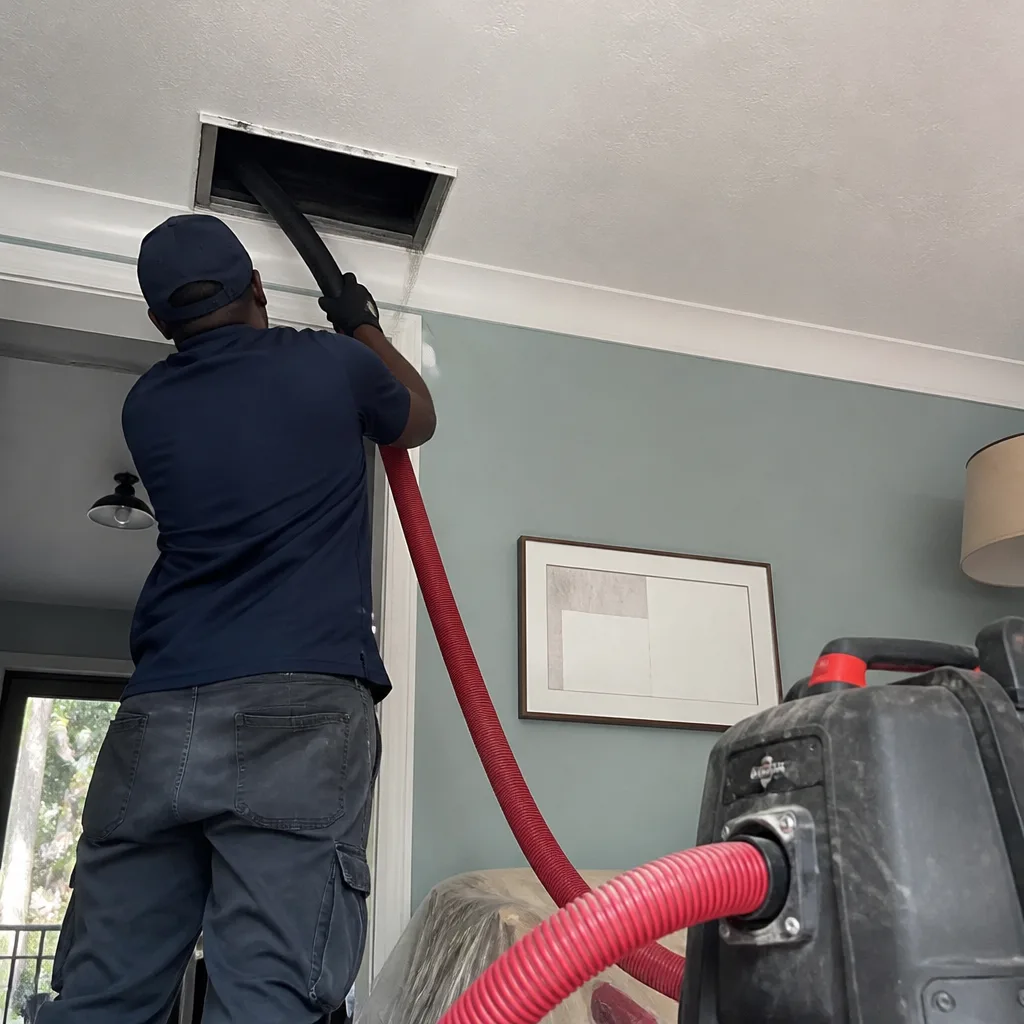
Negative-pressure source removal uses a high-powered vacuum unit, typically truck-mounted or portable, connected directly to the duct system at the trunk line. The vacuum creates sustained negative pressure throughout the entire duct network, meaning air is moving through every branch from every direction toward a single collection point. This is fundamentally different from pushing a vacuum hose into a register, because the entire system, not one opening, becomes the vacuum’s inlet.
At Air Duct Cleaning in Marietta, we then introduce mechanical agitation into the system. Agitation tools, such as rotating brushes, compressed air whips, or pneumatic rods, break debris loose from duct walls. Because the system is under negative pressure, the loosened debris is immediately captured and moved to the vacuum’s collection point rather than escaping into the living space. The loose debris cannot re-settle deeper in the system because the continuous airflow carries it out.
Professional equipment from trade-trusted brands like Nikro is built specifically for this application. These are not consumer vacuums with longer hoses. They are engineered to sustain the cubic-feet-per-minute airflow ratings required to move air through 40 to 80 feet of duct at a velocity sufficient to carry debris. A shop vac underperforms on both airflow and endurance.
In addition to extraction equipment, professional duct cleaning in Marietta often incorporates:
- Access hole cutting and sealing: When the duct layout requires it, a technician cuts a small access hole at a strategic point in the trunk, inserts the agitation tool, then seals the hole with a permanent patch. This allows cleaning of duct sections that have no register nearby.
- Compressed air agitation: For flex duct, rotary brushes are too aggressive. Compressed air whips are gentler and reduce the risk of damaging the inner liner while still dislodging debris.
- Video inspection equipment: A small camera that runs into the duct to document conditions before, during, and after the cleaning. This is how a professional proves the work went beyond what a shop vac could do.
For homes looking to improve air quality beyond cleaning, products from Aprilaire and Abatement Technologies can be integrated into the HVAC system. These include whole-house media filtration and duct-mounted UV or purification systems. They are not substitutes for cleaning, but they complement it for Marietta homeowners who deal with seasonal allergies or high dust loads.
What a Professional Should Show You After the Job
This is the section to read before you hire anyone in Marietta. The difference between a legitimate duct cleaning company and a low-bid operation is almost entirely in what the company can show you when the work is done.
A professional duct cleaning job should end with documentation. Specifically, you should receive or be shown:
- Before-and-after video or photos from inside your ducts. A camera run through the trunk and key branches shows the actual condition of the system. If a company cannot show you the inside of your ducts before and after, ask why. The equipment to do this is standard for legitimate operators.
- A written report of what was found. This should note the level of debris, any water staining, any mold-like growth, any disconnected or damaged duct sections, and any pest evidence. It is a record of the system’s condition at that moment.
- Collection of the removed debris in a visible location. The vacuum unit has a collection container. A legitimate company should be willing to show you what came out of your system. We have had Marietta homeowners who have lived in their homes for 15 years open a trash can that contains several pounds of dust, pet hair, and construction debris. Seeing it changes your understanding of what was actually in the system.
- A written price that matches the final invoice. The price should be put in writing before work begins, every time, no exceptions. If the final bill differs from the written quote without a signed change order, that is a red flag, not a normal practice.
We operate under a standard that addresses the core trust problem in this industry. Every technician who arrives at a Marietta home for Linden Air Duct Marietta home services is background-checked, identity-verified, and photo-badged. The technician’s name and photo are sent to the homeowner before the visit. At the door, the technician shows a photo ID badge before entering. This is what our Threshold Standard exists to guarantee.
Beyond the cleaning itself, we put our work under a written guarantee. If the work is not right, we make it right. For Air Duct Repair in Marietta, every repair carries a written guarantee, and if the covered repair fails, we return at no charge.
Cost Comparison: DIY vs Professional in Marietta
Let us put real numbers on the table. In the Marietta metro, professional air duct cleaning for a typical single-family home ranges from $350 to $650 for a full system, including supply and return sides, trunk and branches, and all registers. Larger homes, or homes with multiple systems, run higher.
| Item | DIY Cost | Professional Cost |
|---|---|---|
| Shop vac rental or purchase | $40 to $80 | Included in service |
| Replacement filters (annual) | $30 to $80 | $30 to $80 |
| Full duct cleaning | Not achievable | $350 to $650 |
| Equipment capable of source removal | $3,000+ for consumer-adjacent models | Included in service |
| Time cost | 4 to 6 hours | 2 to 4 hours, you watch |
The DIY case typically breaks down on two points: equipment capability and time cost. Spending $40 on a shop vac that cannot actually clean the ducts is not a savings; it is a distraction. And spending a Saturday in the attic in July, when Marietta attics routinely exceed 120 degrees, is a real cost in comfort and safety.
There is also a middle-ground point worth making: you can do the legitimate DIY tasks yourself and hire a professional for the actual cleaning. Explore more guides & resources on our blog for additional home maintenance tips. That is a sensible division. Clean your registers, replace your filter, inspect what you can see. Then call a company that can prove the rest of the work is done, documented, and guaranteed.
Common Mistakes to Avoid
- Believing a shop vac can clean ducts. It cannot. Single-point suction at a register does not create system-wide airflow, and it often pushes debris deeper into the trunk line.
- Using a stiff brush on a long handle inside flex duct. Flex duct liners tear easily. Once torn, flex duct leaks conditioned air into the attic, which drives up energy costs in Marietta’s cooling season.
- Forgetting that the return side is the dirtiest part of the system. Returns run pre-filter and collect everything your home breathes. Any DIY effort that ignores the returns is missing the largest debris load.
- Replacing a filter with a higher MERV rating than the system can handle. A MERV 13 filter in a system designed for MERV 8 can restrict airflow enough to freeze the coil or overheat the blower. If you want higher filtration, talk to a professional about a media cabinet like those from Aprilaire.
- Ignoring water staining in ducts. Water in ducts means a moisture source exists: a leak, a condensation problem, or a compromised crawlspace vapor barrier. Cleaning the duct without fixing the source means the problem returns in months.
- Choosing a duct cleaner based on price alone. The low-bid operator often uses the bait-and-switch model: a low teaser price that becomes a larger invoice after the van is in the driveway. Ask for a written price before work begins and a written guarantee on the work. If a company will not provide either, walk away.
- Assuming ducts never need cleaning. In Marietta’s climate, with our humidity and pollen, ducts accumulate debris faster than in drier regions. A visual inspection every year tells you more than any national guideline about when your specific home needs service.
See the difference
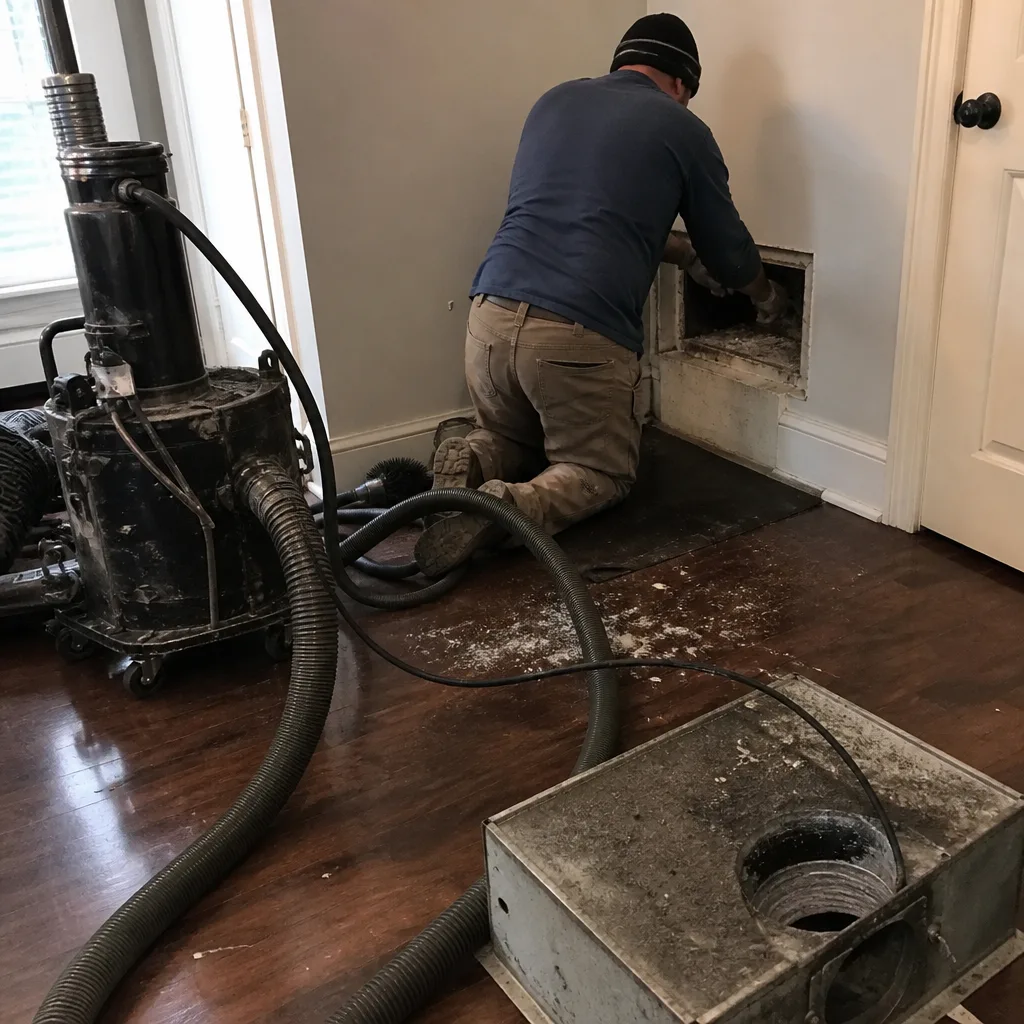 Before
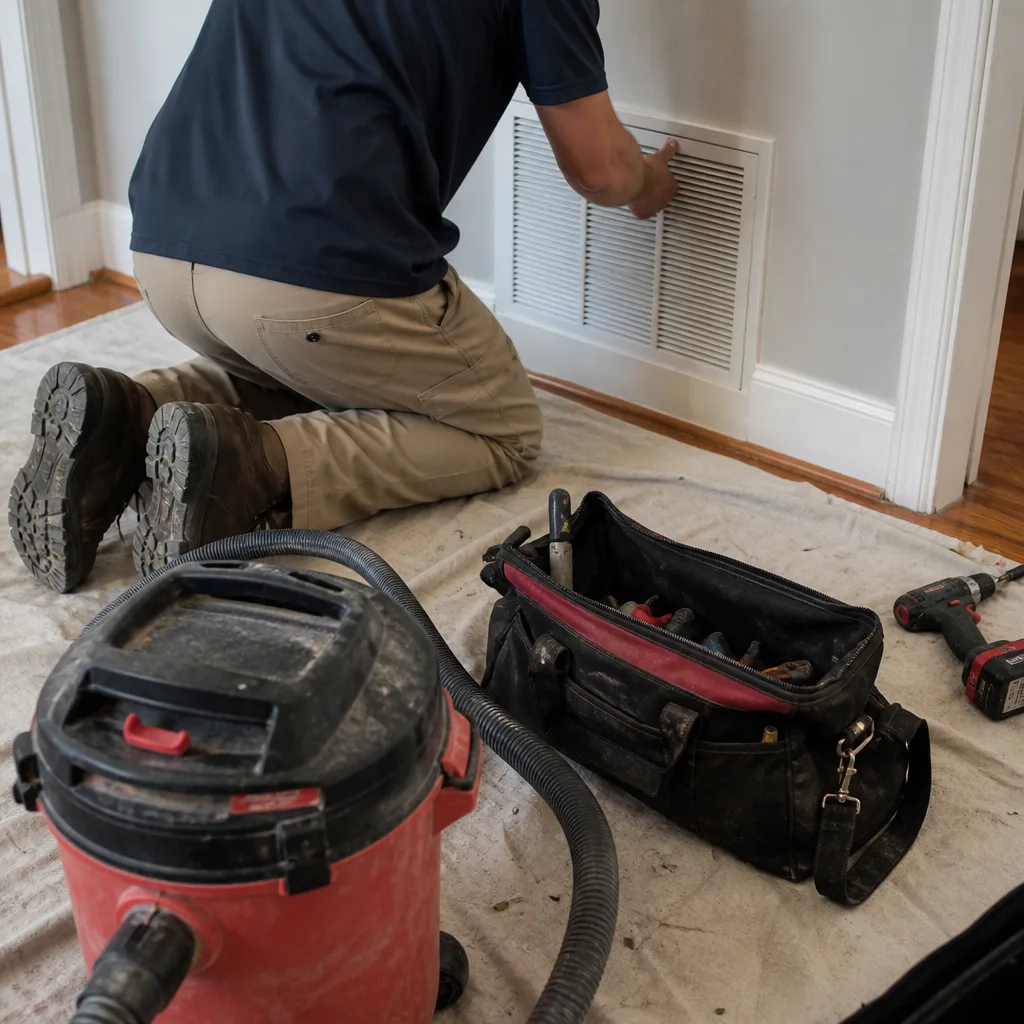 After
After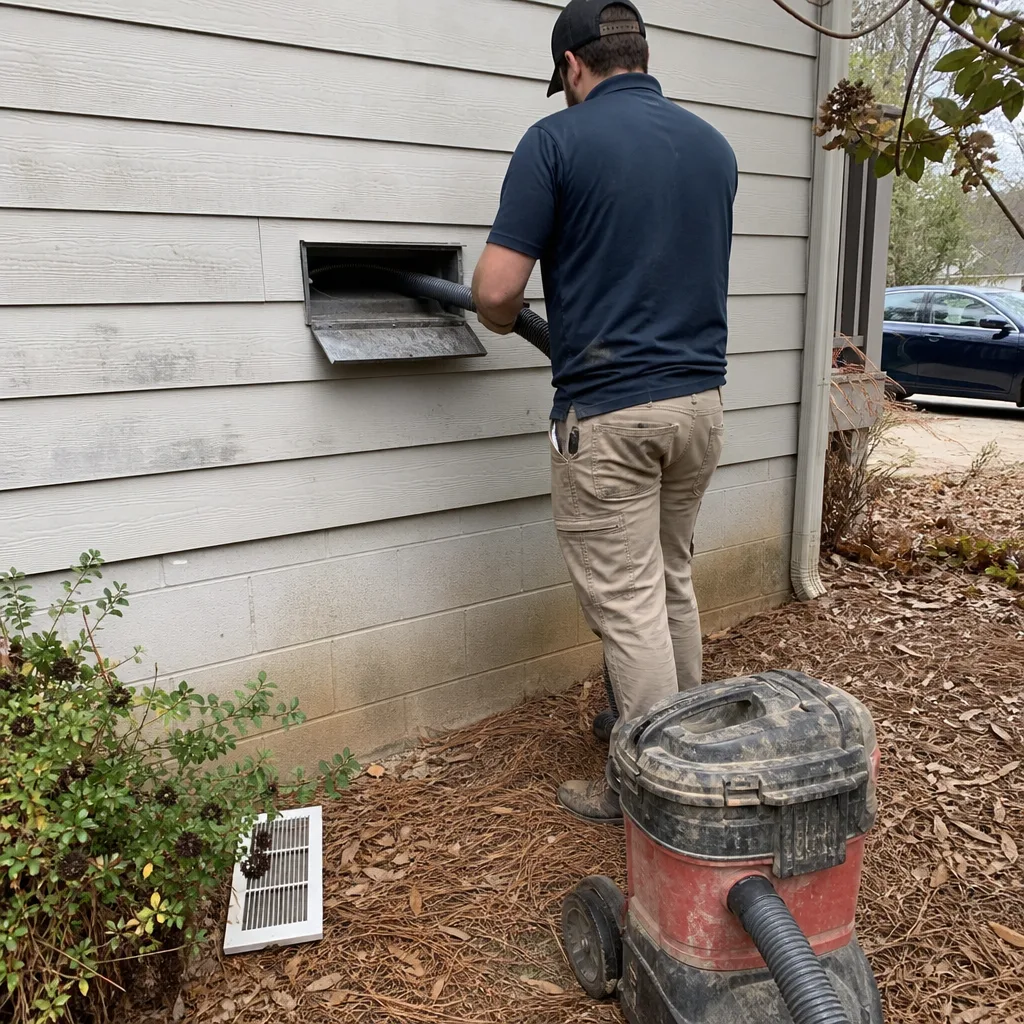 Before
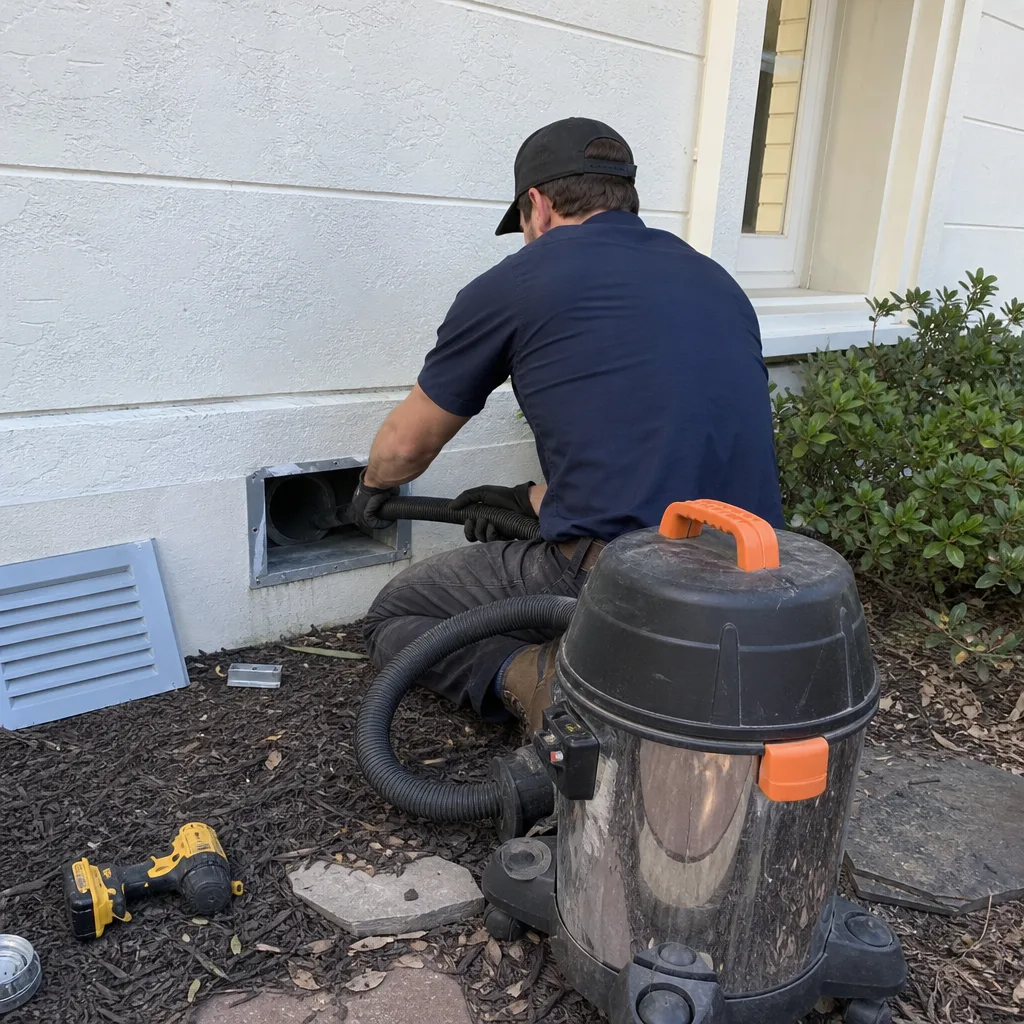 After
After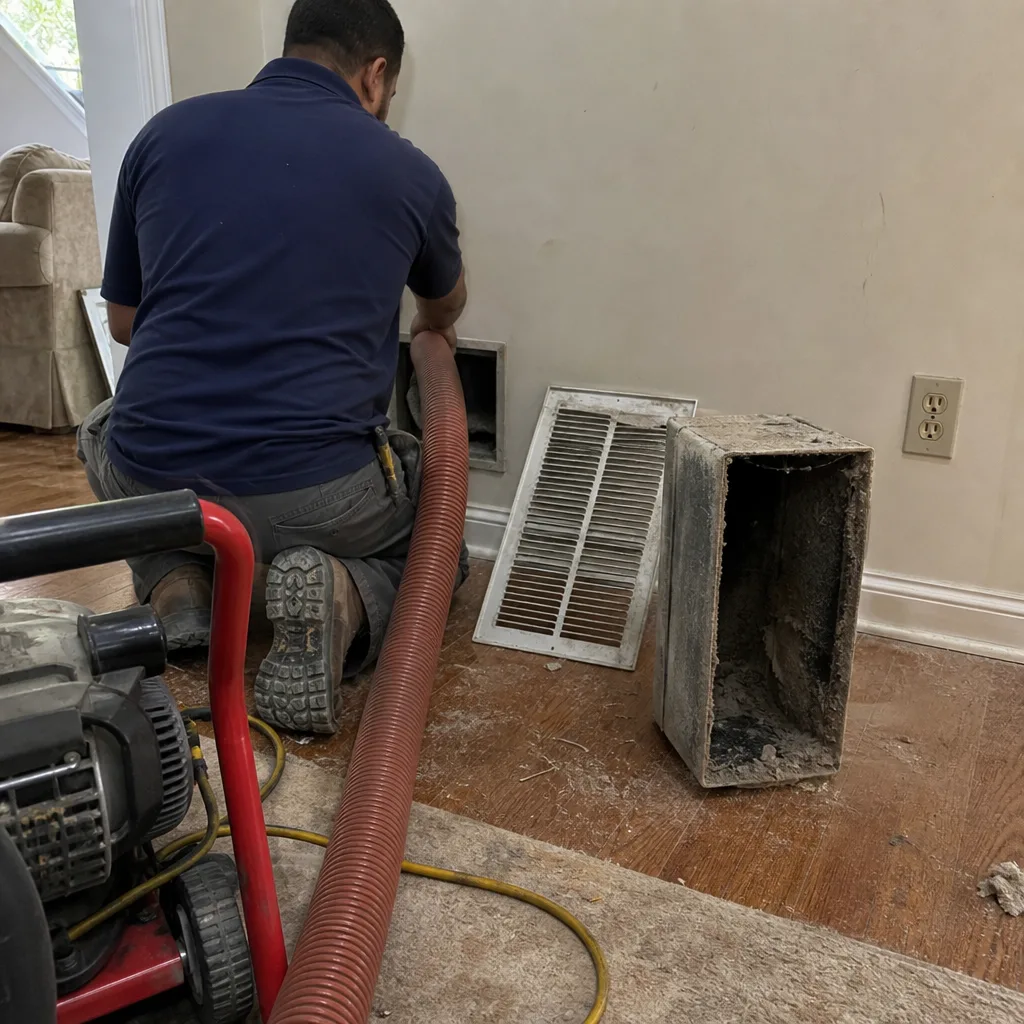 Before
 After
AfterWhen to Call a Professional
Call a professional when you see any of these conditions: visible dust buildup beyond the first few inches of duct, dust blowing from registers when the system starts, water staining or mold-like growth inside ducts, evidence of rodents or insects in the ductwork, or a musty odor that strengthens when the AC runs. Also call if you have recently completed a renovation; construction dust in ducts is extremely fine and settles deep in the system. Finally, call if you have never had the ducts cleaned and the home is more than 10 years old. At that point, the system has accumulated enough Marietta pollen and humidity-seasoned dust that professional cleaning is a legitimate investment. Linden Air Duct Marietta offers free estimates in Marietta – call (912) 405-8840.
Frequently Asked Questions
Full-system air duct cleaning in Marietta typically costs between $350 and $650 for a standard single-family home, with larger homes or dual-system homes running higher. The price should be written and agreed before work begins. If you are quoted a price dramatically lower than this range, ask what the quote includes; low offers in this industry often expand into much larger invoices once the technician arrives and “discovers” additional work. Call (912) 405-8840 for an exact quote for your Marietta home.
Low quotes in the duct cleaning industry typically use one of two models: a bait price that covers only a partial cleaning, or a flat fee that turns into an upsell once the van is at your house. A $99 whole-house duct cleaning in Marietta is not commercially viable for a legitimate operator using professional equipment. The cost of running negative-pressure source removal equipment, paying a background-checked technician, and standing behind a written guarantee cannot be covered at that price. When a quote seems too good to be true, it usually means the actual invoice will be higher, or the work will be superficial.
Ask for before-and-after video or photos from inside your own ducts. A legitimate duct cleaning company can run a camera through the trunk and branches and show you the condition of the system before and after the work. You should also receive a written report of what was found and be able to see the debris collected from your system. If a company cannot produce any of these, you have no way to verify that the cleaning went beyond opening a few registers.
In Marietta’s climate, most homes benefit from professional duct cleaning every 3 to 5 years. Homes with multiple pets, active renovation history, or occupants with allergies or respiratory conditions may need service more frequently. The most reliable indicator is a visual inspection: if you can see dust accumulation beyond the first few inches of duct, or dust is blowing from registers when the system starts, the ducts are overdue regardless of how many years it has been. Call (912) 405-8840 and we can help you assess your system.
DIY duct cleaning is generally not dangerous in the way that working on high-tension springs or electrical panels is dangerous. The risk is different: it is ineffective and can leave your air quality worse than before. The one real safety concern is working in a Marietta attic during summer, where temperatures routinely exceed 120 degrees. Heat exhaustion is a genuine risk for anyone spending an afternoon working in an attic, and it is a risk that has nothing to do with your ducts. If you choose to do attic work, do it in the early morning in cooler months and stay hydrated.
Dryer vent cleaning is a separate service from air duct cleaning, and it matters for a different reason: fire safety. Lint accumulation in a dryer vent restricts airflow, which raises dryer temperatures and can ignite. In Marietta, where laundry rooms are often located in the center of the house, a dryer vent fire has limited escape paths. We recommend Dryer Vent Cleaning in Marietta annually for most homes, more often if you have a long vent run or dry large loads frequently. A dryer vent clogged with lint operates hotter and takes longer to dry clothes. If your dryer has been taking longer than 45 minutes per load, the vent likely needs attention.
The Bottom Line
DIY duct cleaning in Marietta is honest work only within a narrow band: cleaning register covers, replacing filters, and inspecting what you can see. The actual cleaning of your duct system, the removal of two decades of pollen and humidity-caked dust from 60 feet of trunk and branch, is a job that requires negative-pressure source removal equipment. In our experience cleaning ducts in Marietta since 2004, the homeowners who get the best results are the ones who understand the physics: that suction at one register is not cleaning, that humidity cycles bond debris to duct walls, and that a written price and a written guarantee are the minimum standard for letting a technician into your home. If you want to know exactly who is coming to your door, exactly what the job will cost, and exactly what happens if anything falls short, call (912) 405-8840 for a free estimate.
Written by Marcus Veale, Owner at Linden Air Duct Marietta, serving Marietta since 2004.